LASIK
A laser makes a thin flap in the cornea, a second laser reshapes the tissue beneath, and the flap seals back by itself.

A laser makes a thin flap in the cornea, a second laser reshapes the tissue beneath, and the flap seals back by itself.

A few hours at the clinic. The laser itself takes moments.
Your eye is numbed and the lids held open.
A laser makes a thin flap, and the surgeon lifts it.
A second laser reshapes the cornea, tracking your eye as it moves.
The flap seals by itself. You rest and go home with a companion.
Most daily tasks can usually resume the next day. Typical, not promised; healing differs from person to person.
Watery, scratchy eyes for a few hours. Many see well the next morning.
Back to work and screens. Wear eye shields at night and do not rub.
The flap heals and vision settles. Drops ease any dryness.
Your surgeon will go through these with you before you decide.
Felt as a sandy sensation, mild blurring or light sensitivity; this usually improves within weeks.
Glare or halos around lights at night.
Some prescription returning over time, more often with high nearsightedness; a second treatment is sometimes possible.
Both are uncommon.
Weakening and bulging of the cornea, which is rare. Measuring the cornea before treatment is how this is avoided.
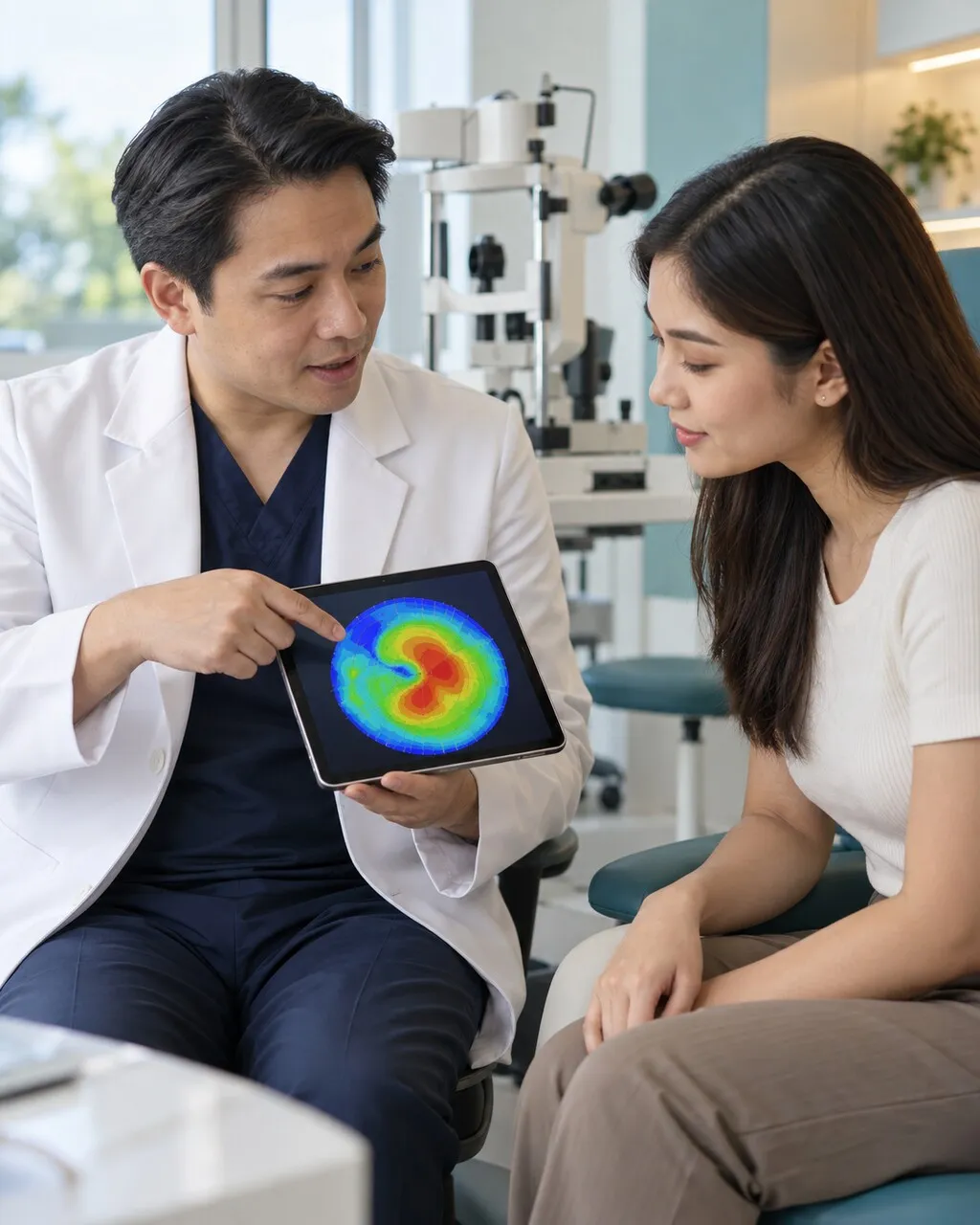
The laser takes moments per eye. Plan for a few hours at the clinic in total.
Usually yes. Your surgeon will confirm this at your screening.
Only once your surgeon has checked your vision at the follow-up visit and said you can.
The laser removes a little tissue. If too little would remain the cornea could weaken, so a thin cornea may point to PRK instead.
A screening measures your eyes and ends with a plain answer.
Or call or Viber reception on 0916 670 5176 or 0917 884 7466. Tuesday to Saturday, 6 am to 4 pm.
May we use Google Analytics to count page visits and consultation link clicks? We do not send your form details. You can change your choice in Analytics settings. Read our privacy notice.